
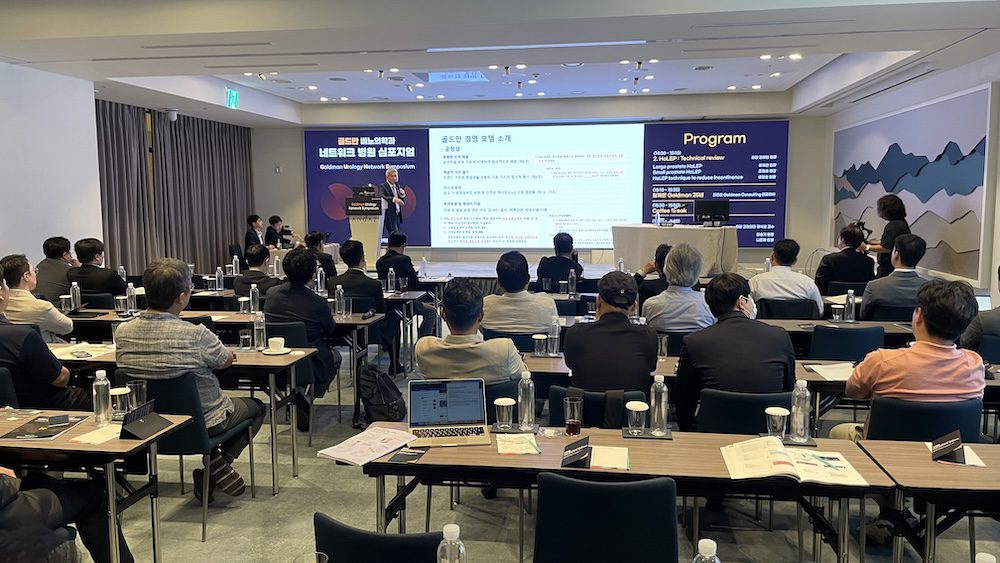
The 7th Goldman Urology Network Hospital Symposium, hosted by the Goldman Urology Group (CEO Dr. Chang-Ki Lee), successfully concluded on November 9th at Andaz Seoul Gangnam. This annual event, designed as an academic conference centered on private practice, consistently elevates its scholarly quality by featuring presentations from both Goldman network directors and university hospital professors. This year, prominent urology professors from Kyung Hee, Yonsei, Korea, Catholic, and Soonchunhyang Universities participated as key speakers.
The “Evidence-Based Urology” session commenced with Professor Jung-Woo Lee of Kyung Hee University and Professor Kyung-Taek Oh of Yonsei University, who introduced the latest guidelines for urinary tract infections (UTI) and lower urinary tract symptoms/benign prostatic hyperplasia (LUTS/BPH), respectively. Professor Lee highlighted the evolving patterns of antibiotic resistance in Korea, emphasizing the need for treatment strategies tailored to domestic clinical realities, considering the diverse types of uropathogens, infection timing, patient gender, and infected organs, while referencing US and European guidelines.
Professor Oh then outlined various advanced surgical techniques for LUTS/BPH, stressing that treatment should not follow a unidirectional path from medication to transurethral resection of the prostate (TURP). What factors should be considered when choosing a treatment for lower urinary tract symptoms or benign prostatic hyperplasia? Professor Oh advocated for a comprehensive shared decision-making process, incorporating factors such as general anesthesia eligibility, desire for ejaculation preservation, bladder function, prostate volume and morphology, financial considerations, and management of antiplatelet/anticoagulant therapies. He also proposed that future research should identify anatomical subtypes that best respond to specific minimally invasive surgical treatments (MISTs), suggesting that meticulous cystoscopic evaluation and mechanism-based matching to patient anatomy remain the most rational framework until sufficient evidence emerges.
The second session, “HoLEP Technique Review,” featured Goldman Urology directors Dr. Je-Man Ryu, Dr. Jung-Ho Cho, and Dr. Kyung-Ho Ryu, who shared practical tips based on their extensive clinical experience. Dr. Je-Man Ryu discussed his experience with HoLEP for large prostates (100cc-300cc), emphasizing the importance of careful patient selection and swift resection to avoid fatigue and visibility issues from prolonged surgery and bleeding. Dr. Jung-Ho Cho presented his experience with HoLEP in smaller prostates, noting that a small prostate does not necessarily imply mild obstruction and that recent studies support HoLEP as an effective treatment even in these cases. Dr. Kyung-Ho Ryu shared techniques to minimize the incidence of urinary incontinence after HoLEP, demonstrating the feasibility of safely performing complex surgeries in private clinics through real-world examples. These practical insights from Goldman Urology specialists underscored the versatility and evolving techniques of HoLEP across various prostate sizes and patient needs.
Following these presentations, Dr. Jung-Ho Cho, CEO of Goldman Consulting, reflected on “Goldman’s 25 Years Together,” tracing the network’s growth trajectory. The “Semi-Live Urolithiasis Surgery” session garnered significant attention as Goldman Urology directors Dr. Seung-Ki Min and Dr. Joon Chae Na shared their expertise through near-live demonstrations of urolithiasis treatment. Dr. Seung-Ki Min presented five principles for safe semi-rigid ureteroscopy (URS), including predicting difficult cases via CT, prioritizing axis and rotation over force during entry, considering guide wire and mucosal status for impacted stones, always checking the ureteral wall when using lasers or baskets, and opting for safe staged procedures over aggressive complete removal.
Dr. Joon Chae Na demonstrated robot-assisted flexible ureteroscopy (RIRS and Zamenix), proposing an integrated strategy for complex kidney stone treatment. How are complex kidney stones being treated with advanced technology? Dr. Na explained that this integrated strategy—RIRS for access, FANS for removal, and Zamenix for control—offers a realistic direction for safer and more efficient treatment of complex kidney stones.
The “New Surgical Techniques” session explored the expansion of surgical scope in private practice. Professor Shin Dong-Ho of Catholic University presented on perineal prostate biopsy (TPBx), noting that the infection risk and antibiotic resistance burden of transrectal biopsy (TRBx) are driving a shift towards TPBx. Citing the PREVENT-ProBE-PC study, he explained that antibiotic-free TPBx is as safe as antibiotic-assisted TRBx, with comparable infection and cancer detection rates. However, Professor Shin also provided a balanced perspective, referencing the PERfect study, which suggests TPBx is not always superior and results can vary based on lesion location and MRI utilization. He emphasized that the large-scale randomized controlled trial TRANSLATE study has shown TPBx can be superior in detection rates, and international guidelines from EAU and AUA/SUO now recognize TPBx, narrowing previous gaps. Dr. Jo In-Chang of Police Hospital then presented cases of laparoscopic surgery application in urology clinics, highlighting the potential for expanding surgical capabilities in private practices.
The final invited lecture session concluded the academic proceedings, with Professor Bae Jae-Hyun of Korea University discussing treatment approaches for bladder pain syndrome patients, and Professor Kim Jae-Hyun of Soonchunhyang University presenting optimal treatment strategies for localized prostate cancer. Dr. Seung-Ki Min, leading the event, remarked, “This seventh symposium was meticulously prepared to share the latest knowledge in urology and collectively explore the future vision for the Goldman network.” He expressed hope that the intense discussions and warm exchanges would serve as a solid stepping stone for a better tomorrow for patients and further advancement for the network. The symposium is lauded as a model for private practices to verify clinical competence and share expertise, attracting not only private practitioners but also university professors and residents annually.